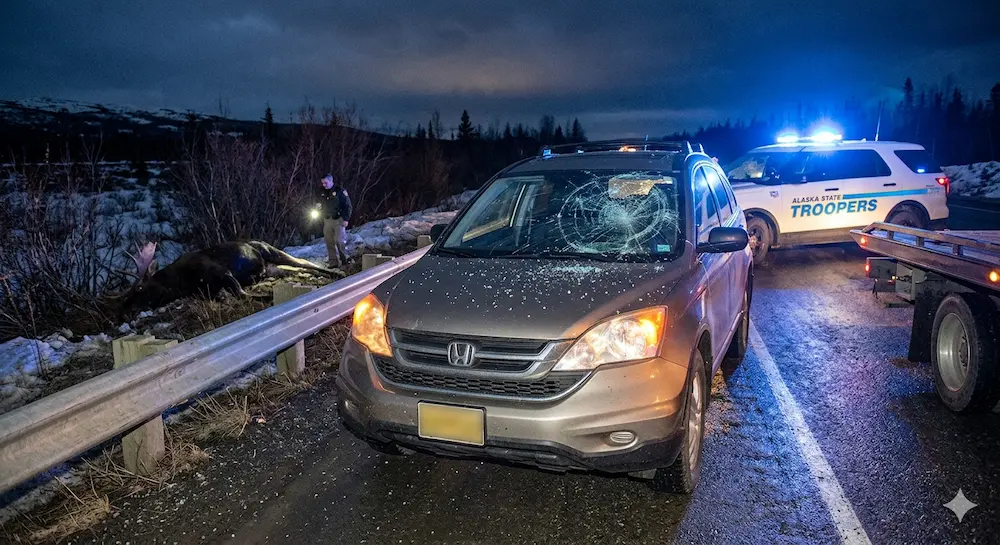
You’re driving the Glenn Highway at dusk, and suddenly there’s a moose standing in your lane. It happens fast. Whether you hit it at speed or caught it with a glancing blow, the damage to your vehicle can be serious — and windshield damage is one of the most common outcomes.
Alaska sees an average of 800 moose vehicle collisions every year. When a vehicle strikes a moose, the animal’s long legs absorb the initial impact at bumper level — then its body and head come down directly onto the hood and windshield. A moose can weigh anywhere from 800 to 1,600 pounds. That is roughly half the weight of a compact car coming down on your glass.
If it happened to you, here is exactly what to do — starting from the moment you stop the vehicle.
Step 1: Get Safe First
Pull off the road if your vehicle can move. Turn on your hazard lights. Do not approach the moose, even if it appears still. A wounded moose is unpredictable and can cause serious injury.
Check yourself and your passengers for injuries before you do anything else. Airbags may have deployed. Glass may be inside the cabin. Take a breath and assess before stepping out.
Step 2: Call Alaska State Troopers
Reporting a moose collision is required in Alaska if there is significant vehicle damage or if the animal is killed. Call 911 or the Alaska State Troopers non-emergency line.
Troopers will document the scene and, if the moose was killed, will typically contact the Alaska Department of Fish and Game. In some cases, the meat is donated to food banks — but do not attempt to remove or harvest the animal yourself. Violating Alaska wildlife laws can result in significant fines and loss of hunting privileges.
Step 3: Document the Damage — All of It
Before your vehicle is moved or towed, photograph everything:
- Every crack and impact point on the windshield
- Side windows, rear glass, and the roof if impacted
- The exterior hood, grille, and A-pillars
- Any interior glass or debris inside the cabin
- The road scene and surroundings
This matters for your insurance claim. Comprehensive claims are based on documented damage at the time of the incident. The more photos you have, the smoother the process.
Step 4: Understand Your Insurance Coverage
This is the part that surprises most Alaska drivers: a moose collision is not covered under your collision insurance. It is covered under comprehensive coverage.
The difference matters because comprehensive deductibles are typically lower than collision deductibles — and many Alaska comprehensive policies cover auto glass with zero deductible. The Alaska Division of Insurance confirms that hitting any animal, including a moose or bear, falls under the comprehensive portion of your policy.
When you call your insurer, tell them clearly: “I hit a moose and need to file a comprehensive claim for vehicle and glass damage.” That framing gets you to the right department faster.
We work directly with all major Alaska insurers and handle the paperwork on your end. Most of our customers pay nothing out of pocket for glass after a moose hit.
Step 5: Is Your Windshield Safe to Drive With?
This depends entirely on where the damage is and how severe it is.
Do not drive if:
- The crack runs through the driver’s direct sightline
- The crack has reached the edge of the glass (the seal is compromised)
- Large sections of glass are missing, cracked through, or pushed inward
- The A-pillar or roof shows structural damage that may affect glass stability
You may be able to drive carefully if:
- The damage is a single crack on the passenger side away from your sightline
- The crack is not at the edge of the glass
- No glass has entered the cabin
When in doubt, do not drive it. A compromised windshield reduces your vehicle’s structural strength in a subsequent accident. In Alaska, where road conditions can deteriorate rapidly, that is not a risk worth taking. Call for mobile service and have us come to you.
What Kind of Glass Damage Happens in a Moose Collision?
Moose hits tend to produce a specific pattern of damage that is different from a rock chip or a minor fender bender:
Windshield impact damage is the most common. The moose’s body or antlers strike the glass at speed, creating a large starred impact point or a series of radiating cracks across the upper half of the windshield.
A-pillar damage happens when the moose’s body catches the corner of the windshield frame. This can crack the glass along the edge and compromise the seal around the entire windshield.
Roof glass and sunroof damage occurs when the moose rolls up and over the hood at higher speeds. The rear portion of the animal can land on the roof, shattering any glass panel there.
Side window damage is less common but happens in sideswipe collisions where the moose strikes the vehicle at an angle rather than head-on.
In almost all moose collision scenarios, a full windshield replacement is required rather than a repair. The impact forces involved are simply too great for resin injection to restore structural integrity.
ADAS Recalibration After Replacement
If your vehicle was built after 2018, it almost certainly has a forward-facing camera mounted at the top of the windshield. This camera powers your lane-keep assist, automatic emergency braking, and other safety systems.
A full windshield replacement shifts the camera’s position slightly relative to the glass geometry. Without recalibration afterward, those systems can misread the road or stop functioning correctly.
We include ADAS recalibration with every applicable replacement — no separate appointment, no extra charge. After a moose hit, your vehicle has already been through enough. We make sure everything that should work, works.
How Soon Can You Get It Fixed in Anchorage?
Same day, in most cases. We offer mobile service across Anchorage, Eagle River, Wasilla, Palmer, Midtown, Downtown, and Girdwood. We come to your home, your workplace, or wherever your vehicle is sitting after the collision.
If your vehicle was towed after the incident, we can meet it at the body shop or repair facility. Just let us know the location.
Glass is almost always the fastest part of the repair after a moose collision. Body panels, hoods, and frame damage take longer. Many of our customers have us handle the windshield first so the vehicle is safe and weathertight while the rest of the repairs are scheduled.
Quick Reference: After a Moose Collision
Step | What to Do |
1 | Get to safety, turn on hazard lights |
2 | Do not approach the moose |
3 | Call Alaska State Troopers (required) |
4 | Photograph all glass and vehicle damage |
5 | File a comprehensive claim (not collision) |
6 | Do not drive if windshield is in sightline or at edge |
7 | Call for same-day mobile glass replacement |
Call Us After a Moose Hit
Moose collisions are stressful. The last thing you need is a slow, complicated glass replacement process on top of everything else.
Call us or visit autoglassanchorage.com/contact. We will confirm your coverage, come to your location, and have your windshield replaced and recalibrated the same day. Insurance handled directly — most customers pay nothing out of pocket.