
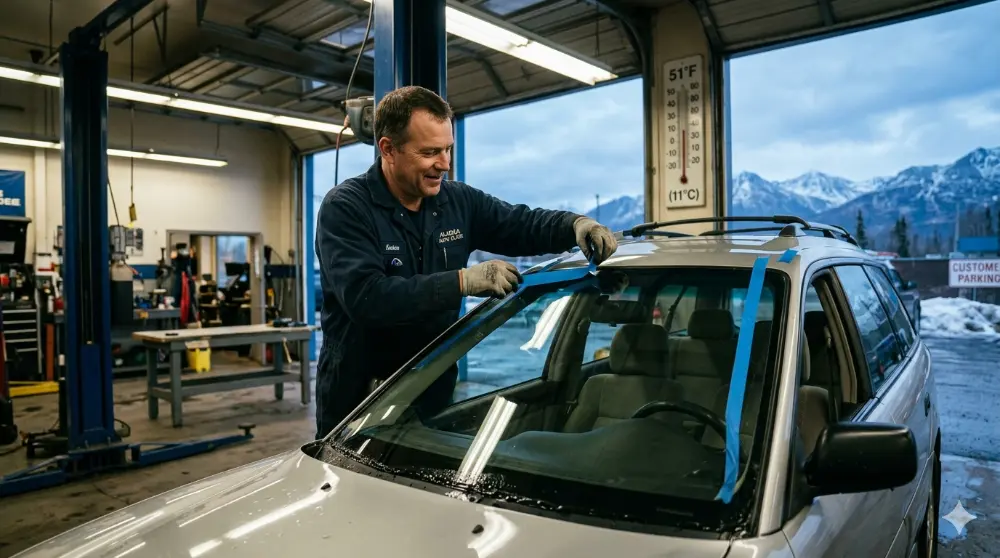
Most drivers in Anchorage should wait at least one hour before driving after a windshield replacement, and often longer once you account for Alaska’s cold. That one hour minimum, called the safe drive away time, is the point at which the urethane adhesive has cured enough to hold the glass securely in a crash. In freezing temperatures, which describes most of the year here, that window commonly stretches to two hours or more, and a technician working outside in deep cold may recommend waiting even longer. The exact number depends on the adhesive used and the temperature at the time of installation, and a reputable shop will always tell you the specific time before you leave.
That is the short answer. Here is everything behind it, including why cold weather changes the math so much in this climate.
What Safe Drive Away Time Actually Means
Safe drive away time, often shortened to SDAT, is not a marketing term. It comes from federal vehicle safety standards, specifically FMVSS 212 and FMVSS 208, which require a windshield to stay in place during a crash and to support proper airbag deployment. Your windshield is not just a piece of glass sitting in a frame. It is bonded to the vehicle structurally, and in many vehicles it contributes to roof strength and the path an airbag follows when it deploys.
The adhesive holding it in place is a urethane sealant, not a standard glue. It cures through a chemical reaction, and until that reaction reaches a minimum threshold, the bond is not strong enough to be trusted in a collision. Drive away time is the answer to one specific question: how long until that bond is strong enough to handle a crash, not how long until the windshield looks finished.
Why the Wait Is Longer in Anchorage Than in Warmer Climates
Urethane adhesive cures through a reaction that depends partly on temperature and partly on ambient humidity. Warm air speeds the reaction along. Cold air slows it down, sometimes significantly.
Anchorage spends a large part of the year below the temperature range where urethane cures at its fastest rate. When outside air is near or below freezing, the chemical reaction inside the adhesive simply happens more slowly, regardless of how skilled the technician is. A bond that might reach safe strength in 60 minutes on a 70 degree day in a heated shop can take noticeably longer when the same adhesive is applied in 20 degree air, especially during a mobile installation done outdoors or in an unheated garage.
This is not a guess specific to this blog. It is the same reason adhesive manufacturers publish separate cure charts for cold weather application, and why a properly trained technician will adjust their recommended wait time based on the actual temperature that day, not a flat number copied from a warm climate shop’s website.
Indoor Installation Versus Mobile Installation in Winter
Where your windshield gets installed changes the timeline more than most people expect.
A windshield installed inside a heated shop bay is curing in stable, controlled conditions close to the adhesive’s ideal range. A windshield installed outdoors during an Anchorage winter, even carefully and correctly, is curing in air that may be sitting well below freezing. Many shops offering auto glass repair Anchorage residents rely on will use adhesives specifically rated for cold weather application, and some will extend the recommended wait time for outdoor winter jobs specifically because they know the chemistry is working slower than it would indoors.
If you are scheduling a mobile installation during winter, it is worth asking directly whether the job will happen in a heated space or outside, since that single detail can change your wait time by an hour or more.
What Happens If You Drive Too Soon
This is not a rule meant to inconvenience you. Driving before the adhesive reaches safe drive away time creates a real structural risk, and the failure modes are specific.
If a collision happens before the bond cures, the windshield can detach from the frame rather than staying in place, which removes a structural element the vehicle’s roof and airbags were designed around. Airbags in particular rely on the windshield staying put; a front passenger airbag in many vehicles is designed to deploy upward and outward against the windshield’s resistance, and a loose or partially bonded windshield cannot provide that resistance reliably.
Even without a crash, leaving too early can introduce smaller problems. Hard bumps, rough roads, or aggressive driving before the adhesive sets can shift the glass slightly within the still soft urethane, which sometimes shows up later as wind noise, a slow leak, or a seal that fails months earlier than it should have.
Aftercare for the First 48 Hours
The wait before driving is the most important window, but it is not the only one. A few habits during the next two days protect the bond while it finishes curing fully, since drive away time is a minimum, not a finish line. Full cure typically takes considerably longer, often a full day or more in cold conditions.
Avoid slamming doors for the first day, since the pressure spike inside the cabin can briefly push outward against a windshield that has not fully cured. Skip the car wash, especially a high pressure one, for at least 48 hours, since direct water pressure aimed at the edge of the glass can compromise an adhesive bond that has not finished setting. Leave any retention tape in place for at least 24 hours rather than peeling it off out of habit. And if your vehicle is parked outside in Anchorage cold overnight after a replacement, cracking a window slightly can help equalize pressure and reduce condensation buildup against the new seal.
A Quick Note on ADAS Equipped Vehicles
If your vehicle has driver assistance features such as automatic emergency braking, lane departure warning, or adaptive cruise control, there is usually a camera or sensor mounted near the top of the windshield. After a replacement, that system needs to be recalibrated to the new glass before those features will work accurately. This recalibration is a separate step from the adhesive curing and does not change your drive away time, but it does add to the total appointment length, and it is not something to skip. A shop handling auto glass repair Anchorage drivers trust should tell you upfront whether your vehicle requires this step.
What to Ask Your Technician Before You Leave
The safest approach is simple: ask for your specific drive away time before you leave the shop or before the mobile technician packs up. A good answer accounts for the exact adhesive used, the outside temperature during installation, and whether the job was done indoors or outside. If a shop gives you the same flat answer regardless of the weather, that is worth a follow up question, because Anchorage conditions genuinely change the chemistry involved.
The Bottom Line
Plan for at least one hour before driving after any windshield replacement, and expect that number to grow during Alaska’s colder months, sometimes to two hours or more depending on conditions. The wait exists for a structural safety reason, not as a formality, and cutting it short trades a small amount of convenience for a real risk in the event of a crash. A trustworthy technician will give you a specific, weather adjusted number rather than a generic one, and following their aftercare guidance for the next two days protects the investment you just made in your new glass.