
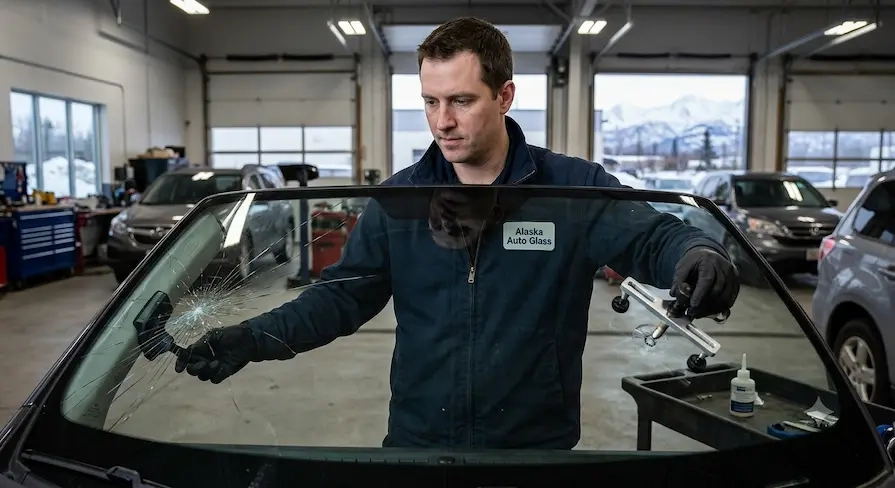
If you are staring at a crack or chip on your windshield right now, the first question in your head is probably the same one every Anchorage driver asks: do I need to repair this, or replace the whole thing?
The honest answer depends on a few specific factors, and getting it right matters more here than in most places. Alaska’s road conditions, extreme temperature swings, and long winters mean that the wrong call on this decision either costs you money you did not need to spend, or leaves you driving around with glass that is no longer structurally sound. This guide walks through exactly how auto glass repair Anchorage professionals evaluate that decision, so you can walk into any shop already knowing what to expect.
What Is a Windshield Repair, Exactly?
A repair means a technician injects a clear resin into the damaged area, uses UV light to cure and harden it, then polishes it flush with the glass surface. The whole thing takes 30 to 45 minutes and costs $75–$120 in most cases.
When it works well, the resin restores most of the glass’s structural strength and makes the damage nearly invisible. You’ll usually still see a faint mark under the right lighting angle, but the crack stops spreading and the glass is solid again.
Repair is only possible when:
- The chip is smaller than a quarter (roughly one inch across)
- The crack is shorter than 6 inches
- The damage hasn’t reached the outer edge of the glass
- The crack isn’t directly in the driver’s line of sight
- The chip hasn’t been sitting open through multiple freeze-thaw cycles with water contamination inside
If your damage checks all those boxes, windshield repair is almost always the right call — faster, cheaper, and just as effective structurally as replacement when done properly.
When Does It Need a Full Replacement?
Replacement means removing the entire windshield, cleaning the frame, installing a new OEM-quality pane, and sealing it with professional urethane adhesive. It takes 60 to 90 minutes and costs $200–$500 for most vehicles in Anchorage, depending on your make, model, and whether your windshield has a heated element or embedded sensors.
You’re looking at windshield replacement when:
The crack is longer than 6 inches. At that length, resin can’t fully restore structural integrity. The windshield contributes to your vehicle’s roof strength in a rollover — a compromised pane is a safety issue, not just a cosmetic one.
The damage is at the edge of the glass. Within about an inch of the frame, the glass is bonded to the vehicle body. A crack there means the seal is already compromised. No amount of resin fixes that.
It’s in the driver’s direct line of sight. Even a clean repair leaves a slight visual distortion under certain lighting. In the middle of the passenger side, that’s fine. Running through where your eyes track the road, it’s not — and in Alaska, with low winter sun glare and ice on roads, you don’t want anything disrupting your vision.
Water has gotten into a chip over several freeze-thaw cycles. Once moisture contaminates the inside of a crack, resin can’t bond properly. You’ll get a repair that looks okay but won’t hold. An honest technician will tell you upfront when the damage is too far gone for resin to work.
The glass is already delaminating or has multiple impact points close together. Multiple chips near each other weaken the same section of glass. At some point the structural math doesn’t work for repair anymore.
Why Timing Matters So Much in Anchorage
This is the part most people don’t think about until it’s too late.
A chip that qualifies for repair in September might not qualify by February. Here’s why: when a chip sits open, water gets in. Anchorage temperatures swing below 32°F and back up constantly through fall and winter. Every time that water freezes, it expands about 9% — and the glass can’t expand with it. The crack grows a little. Then a little more. By the time you get around to fixing it, what was a 30-minute, insurance-covered repair is now a $400 replacement.
The Glenn and Seward highways dump gravel and sand on windshields all winter. Most Anchorage vehicles accumulate chips they never even noticed — too small to see clearly, just sitting there waiting for a cold morning to become a full crack.
The repair window is wide when damage is fresh. It gets narrow fast once Alaska weather starts working on it.
What About Insurance?
If you have comprehensive auto insurance — most Alaska drivers do — your windshield repair is likely covered with zero out-of-pocket cost. Insurance companies prefer paying for a $100 repair over a $400 replacement six months later, which is why most comprehensive policies cover glass generously.
Replacement is also typically covered, though you may have a deductible depending on your policy.
We work directly with all major insurers and handle the paperwork on your end. Before you pay anything out of pocket, it’s worth a five-minute call to your provider to ask whether glass is covered under your comprehensive coverage.
One More Thing: ADAS Calibration
If your vehicle has a forward-facing camera mounted at the top of the windshield — standard on most vehicles built after 2018 — a full replacement means that camera needs to be recalibrated before your safety systems work correctly again.
The camera is set to the exact position and geometry of your original glass. A new windshield, even a perfect installation, shifts that geometry slightly. Without recalibration, your automatic emergency braking and lane-keep assist can give false readings or stop triggering when they should.
Repair doesn’t require recalibration. Replacement does. We include ADAS calibration with every applicable replacement — no extra trip, no separate bill.
The Short Version
Repair | Replacement | |
Chip size | Under 1 inch | Over 1 inch |
Crack length | Under 6 inches | Over 6 inches |
Location | Away from edges and sightline | At edge, or in driver’s view |
Time | 30–45 minutes | 60–90 minutes |
Cost | $75–$120 | $200–$500 |
Insurance | Usually $0 out of pocket | Usually covered, check deductible |
ADAS recalibration | Not needed | Needed on most 2018+ vehicles |
Still Not Sure?
Send us a photo or call and describe it — we can usually tell you in two minutes whether it’s a repair or a replacement, and give you a quote on the spot.
What we don’t recommend is waiting. In Anchorage, a chip ignored through fall is almost always a bigger problem come winter. Repairs are fast, usually covered by insurance, and done at your location — home, office, or wherever you’re parked.
Get a free quote at autoglassanchorage.com/contact or call us directly. We’ll be straight with you about what it needs.